




This blog shares all about
Family and Consumer Science!
If you only see
my most recent post..
Do click on the archive to
view all my posts!
ENJOY!



I'm Jia Li
home economics teacher in training!
join my journey as we explore
the wonders of this amazing subject!

This will be a good post exam activity as it allows students to come up with something personalized and unique to them.
The steps are simple too,

 |
| The end-product, simple yet sweet! =) |
Labels: DCX 130 Teaching Food and Nutrition, something interesting to share

The food commodity: Pulses and Legumes
Menu: Lontong, Vadai, and Ang Ku Kueh

The mango mirror cake is an additional dish that we have to teach..
Absa and Shima taught how to make the sponge cake..
Laura and I taught how to make the frosting and the toppings..
Love the taste of the whipped cream made from the recipe i found online..
There's a strong vanilla taste that i think goes very well with the tangy mango!
The whipped cream tasted like the strawberry short cake from Four Leaves, which I like it a lot! =)
 | ||||
| The process of us (Laura and myself) trying out the Ang Ku Kueh recipe |
Labels: DCX 130 Teaching Food and Nutrition


1) Tempura prawns (which I can't eat due to allergy =S).. Laura made a nice garnish with cucumber!
2) Fish with coconut gravy
3) Sweet and Sour Flower Crab (the crabs are alive and I helped Siti killed like 7 of them! =X).. This is my favourite dish of the day! The sweet and sour sauce is tangy and the chili sauce and crab enhanced the taste! YUM! =)
Labels: DCX 130 Teaching Food and Nutrition

There's Ngoh Hiong (by Fion and Eileen),
Fish Baked Rice (by Eve and Fattasha),
and Egg Tarts (by Li Whey)..
Love the cream cheese tofu sauce most! There's a strong tofu taste initially, but after a while, the tofu taste is gone and all you taste is the rich cream cheese (with calories reduced as tofu reduces the amount of cream cheese used!)..
This is how we serve the dishes!


Labels: DCX 130 Teaching Food and Nutrition
 |
| I like the table setting! Super sweet and elegant~ |
This week's FNN microteaching was on Fruits and Vegetables..
Nur and Shijia taught Carrot Cake with Cream Cheese Frosting!
Xi Ling and Khaty taught Cabbage Roll!
Angela and Jehan taught Cream of Broccoli, Mushroom & Leek and Fruit Trifle!
Labels: DCX 130 Teaching Food and Nutrition

 |
| This is our chicken sambal garnish with chiffonade cabbage |
 |
| Chakchouka & poached egg garnish with baguette |
 |
| Mutton masala (made with yoghurt!) |
Labels: DCX 130 Teaching Food and Nutrition

Group 1 kick started the micro teaching for F&N module..
Their topic is on staple food and the photo above is their demonstration of how to present the dishes for O level coursework A execution.
So, Hidayah and Farah taught tuna fish quiche.
 | ||||
| Our quiche with garnishing =) |
Jay and Mavi taught us how to make Cous Cous (an Egyptian dish).
 |
| Cous Cous we made and garnished! |
Lastly, Mei Zhu and Gmah taught us how to make penne pasta with grilled chicken.
 |
| Serving for 1 ;) |
 |
| The 3 dishes we made for the day! |
Labels: DCX 130 Teaching Food and Nutrition
for DCX 130 Teaching of food & Nutrition,
we had done SOW and coursework B report..
This is what happened during the lab session last week,
each group have to set up a station to collect data for our report...
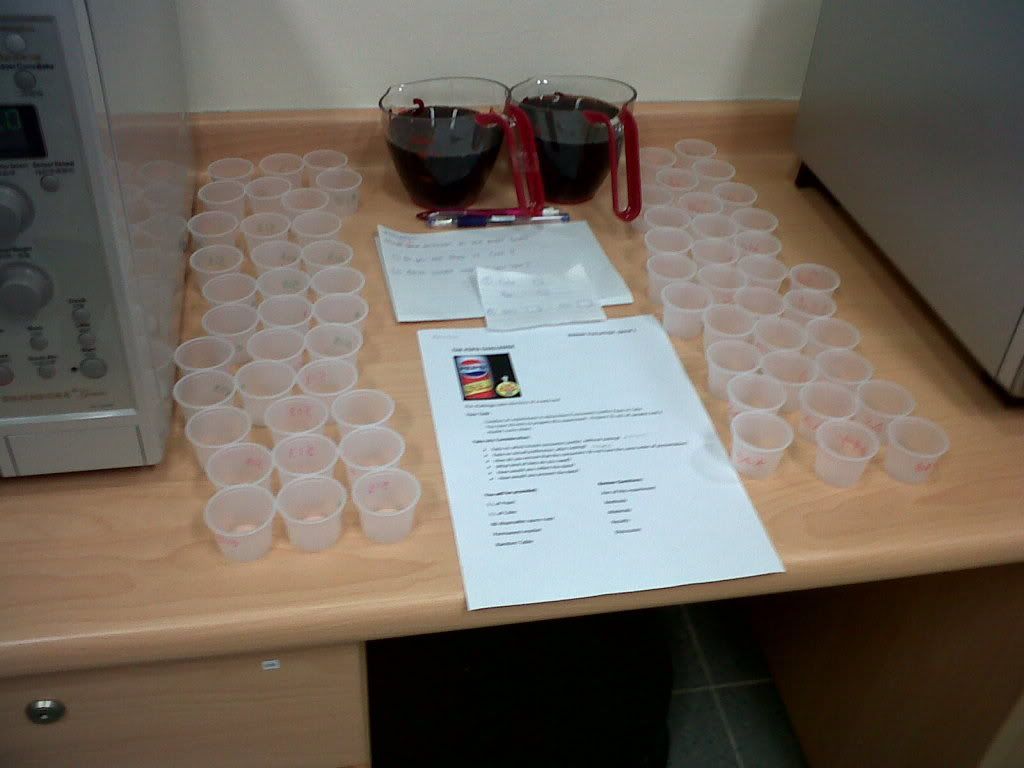
Group 1 (the group I'm in ^-^) - The Pepsi Challenge!
Basically, we would like to determine if the perceived preference will tally with the preference after tasting.
Results collected shows that more subjects prefers Coke to Pepsi both before and after tasting..
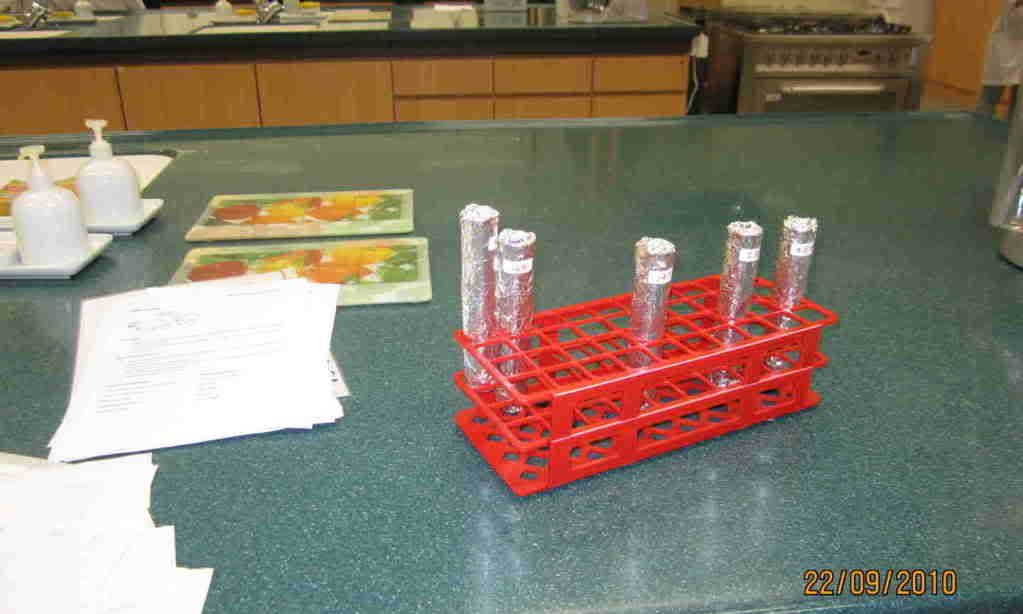
Group 2 - I smell a Rat!
this station, we have to smell 5 different test tubes and try to identify the ingredients in the test tubes.
didnt have sensitive nose so all the test tubes smell bad to me.
there's this pungent smell which i think it's from vinegar..
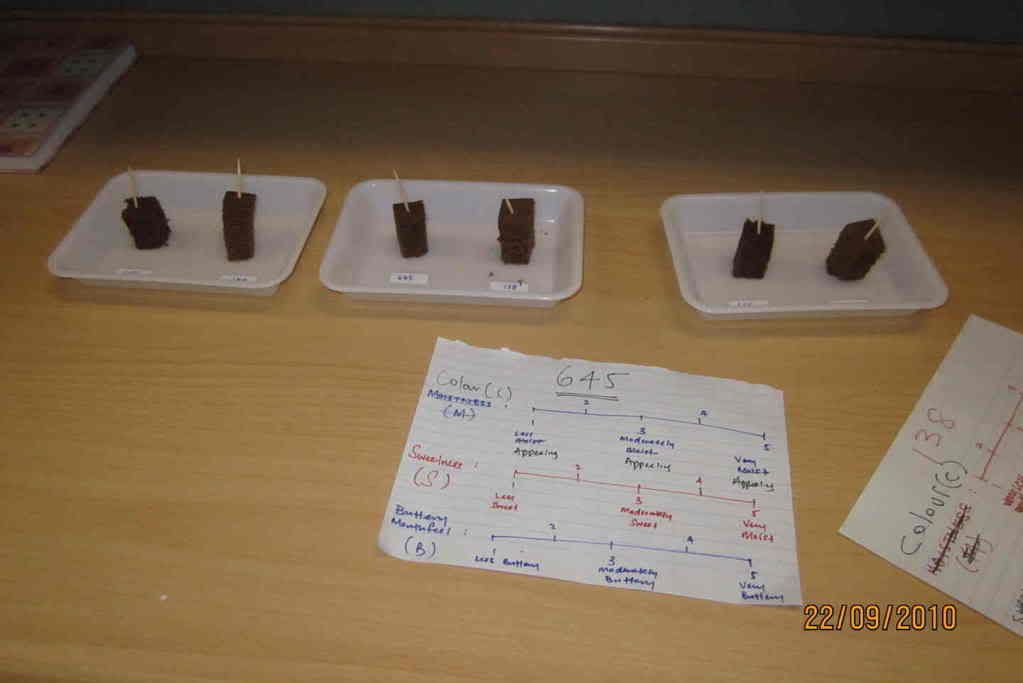
Group 3 - Let them eat cake!
At this station, we are given 2 chocolate cake samples and were asked to evaluate the samples based on sweetness, buttery mouthfeel and colour.
Group 4 - There's a spy among us!
This station uses the classic triangular test, where we have to taste 3 sugar solution and identify the odd one out. There is very little difference in the sweetness and I couldn't really tell which one is the odd one out.

Group 5 - Smell Checkpoint!
I like this station best as I really couldn't tell the flavour of the 4 baby food samples without my sense of smell. I realized I'm so dependent on my sense of smell and without it, food just tasted weird and the texture feels wrong.

Group 6 - Who moved my cheese?!
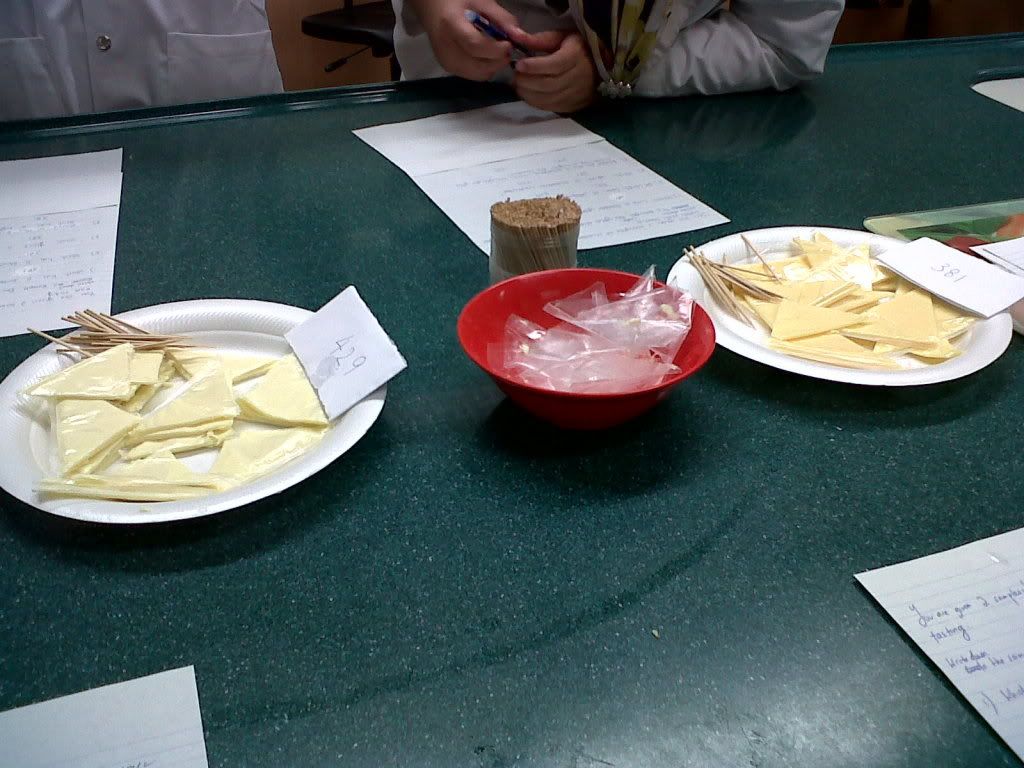
We need to evaluate the 2 cheese sample by colour, milkiness and smoothness to decide which sample is the low fat variation. I find that both tasted very similar, thus I guess I must really give credit to the food manufacturer for making low fat cheese taste just as great as the full fat ones. Save me some calories without compromising the taste! =)
-------------------------------------------------------------------------------
And for our home economics lesson, we'd prepared a coursework for lower secondary..
Now, we're moving on to setting an examination paper..
The first step is to map up all the topics to be covered and start to allocate the marks for each topic.. So we have to come up with the table of specification (TOS) before the actual setting of paper can begin.
This is the sample TOS Ms Chin showed us in class

-------------------------------------------------------------------------------
Lastly for our clothing and textile module, apart from learning how to use the embroidery machines, and preparing samples for my competency profile, I'd made a draw string bag that's super cute as Dr Mok provided us with very sweet looking fabrics!

Labels: DCX 130 Teaching Food and Nutrition, DCX 131 Teaching of Clothing and Textiles, DCX 132 Home Economics Curriculum and Evaluation

Recipe for New York Cheesecake
(from: http://www.momswhothink.com/cheesecake-recipes/new-york-cheesecake-recipe.html)
Ingredients:
Labels: DCX 130 Teaching Food and Nutrition
These websites hosts a collection of video recipes and basic cooking skill demonstrations. These various cooking demonstrations range from very basic dishes/cooking skills, eg cooking of pasta (1st video), to more advanced dishes/cooking skills, eg making of roux(2nd video).
Using of videos for cooking demonstrations is a more efficient way to impart cooking skills to students as compared to traditional cooking demonstration by the teacher during the practical sessions.
Here are some reasons:
1. Can pause/replay steps to emphasize certain important steps
2. The video will have added captions which allow more visual learner to better relate the various steps in the recipe with the actions.
3. In a typical classroom cooking demonstration, only the first row of students can get the best view and the rest who cannot really see will lose their interest in learning. Thus, they miss out on noting down the important steps and proper way to prepare the demonstrated dish.
Therefore, I would search and include cooking demonstrations for the recipes that I would teach for practical and show them to the students taking Food Studies before actually conducting the practical session.
---------------------------------------------------
Review 5 - TeensHealth from Nemours: Food Safety
This article from the site summarizes the various aspects of food safety in an easy to read manner with short paragraphs. Apart from using it when teaching Food Safety, this way of organizing the key points can also be thought to the students so that it helps them in the preparation for the written examination.
In a systematic way, food safety kicks in from choosing:

To storing and cooking:

To cleaning up:

To storing leftovers:

There is still more information available on the site for teens, there is not many articles related to the syllabus of Food Studies. Also, there is not many graphics or interactive activities available that can help to engage the students.
Labels: DCX 130 Teaching Food and Nutrition

This websites uses colourful graphics and is not text-laden, thus I think might engage the students taking Food Studies.
Under the section "choose ur chew", students can select their favourite snack and the counter will show the sum of saturated fat and calories.
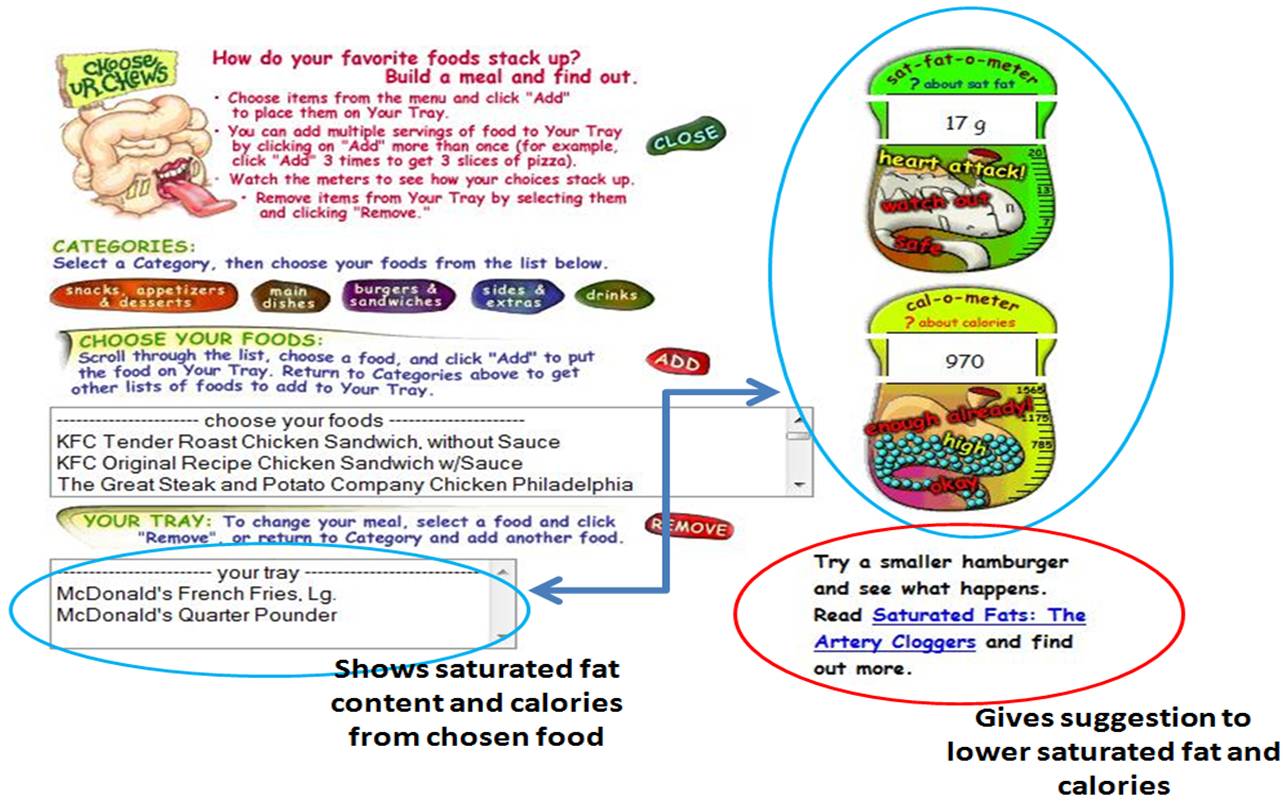
This can be used when teaching the topic on balanced diet whereby this can show the students that food should be eaten in moderation. Through this interactive snack counter, there could be discussion on the function of nutrients (mainly fat) in the body and hidden fat in food. When the calories or saturated fat content is too high due to addition of certain food, there will be suggestion given to improve the diet, as well as related readings. This will let the students know the relationship of the diet and their body, enhancing the importance of a balanced diet.

Other than the above mentioned, there's some food facts and riddles that students can explore on their free time. Overall, I find that this website cover mostly on topics that surrounds saturated fat. It is only useful to a small extend due to the limited content that relates with the Food Studies Syllabus. However, can still be useful if it is used as a tool to engage the students at the start of introducing the topics on "fats and oils" or "balancing diet".
---------------------------------------------------------------------------
Review 3 - Steamy Kitchen
Apart from just providing recipes, this website is also useful when used to introduce the students to ways they can present their food in attractive and appropriate manners.


This website also includes many recipes that involved different methods of cooking. Therefore, while discussing with the students on presentation of food, I can also bring in other components under the topic of food management.
Here's how a recipe post in the website looks:
Super Simple Pate a Choux – Poofy Puffy Pastry! from the Bread category


A negative point is that not all the dishes have detailed recipes/ step by step how-to-do with photos as they merely include links to other sites. Nonetheless, it is one of the many recipe sites that can be used when students are introduced to the concept of food presentation as a picture speaks a thousand words.
Labels: DCX 130 Teaching Food and Nutrition
This website is very useful for the students in their coursework as the tools, data-based and articles are tailored to the Singapore context.
As the website not only covers food and nutrition related topic and resources, but also on other health concerned issues, it is also suitable for all that are health conscious or wanted to find out more about health-related issues to visit!
Since the focus of the review will be on the suitability of the website for teaching food studies, I'll be discussing on the food and nutrition related resource. (Do explore the other sections!)
Here we go!

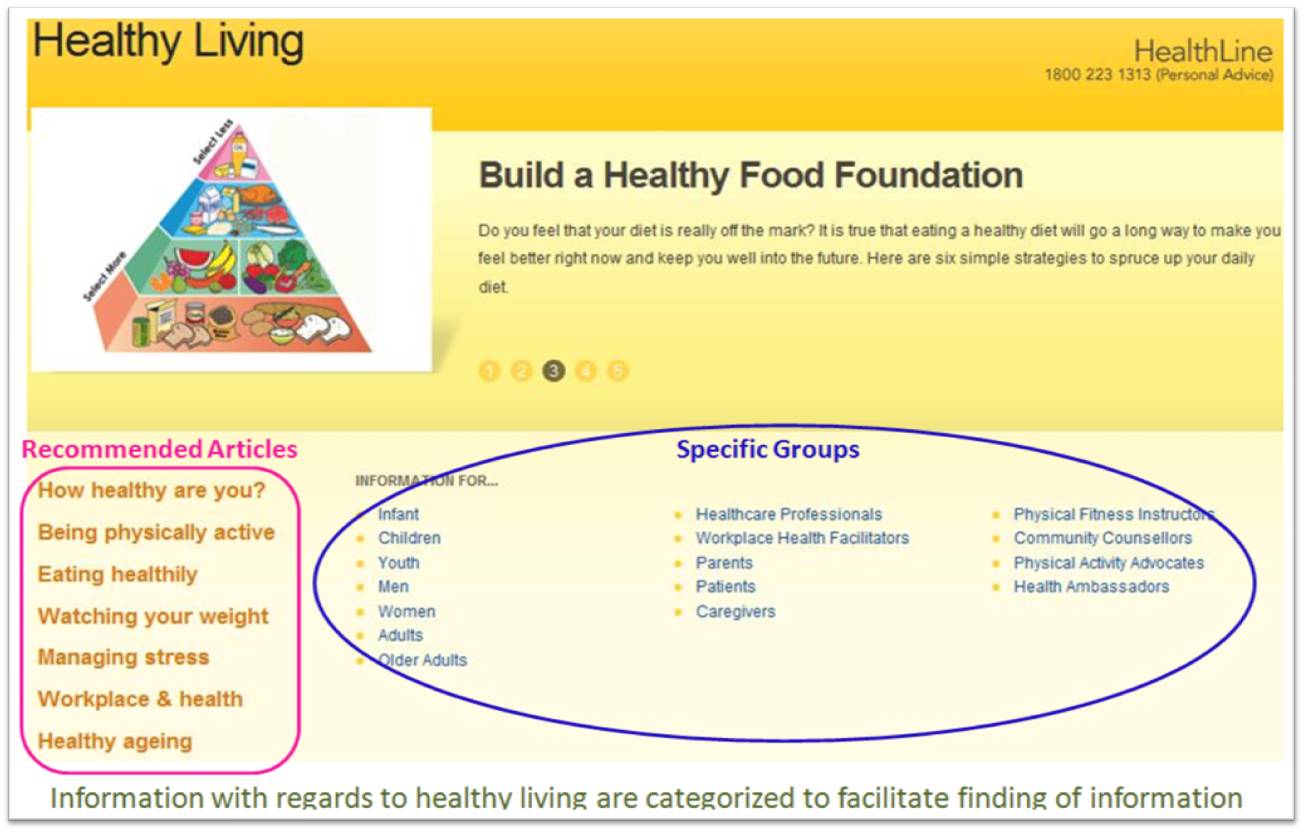
Apart from articles where students can read up for information, they can also find the Singapore Recommended Daily Dietary Allowance from this website.
As the students need to plan the menu for their coursework, they need to know the RDDA for their target group before the actually planning can be done.

The HPB website also provide a variety of useful health tools for the students to choose and use.

The tool to highlight here will be the Energy and Nutrient Composition of Food.
When teaching the students meal planning, this tool can be introduced.
After the students planned their menu, they can check if their menu meets the RDDA for their target group by selecting the foods and tabulating the data.
One plus point of this is that students can find the energy and nutrient composition of local dishes and delicacies, unlike other food composition data-based by other countries.


Apart from the above tools, there's this section on Educational Materials where booklets and other materials can found.

The above are examples of educational materials (information booklets). Such booklets like All About Fruits and Vegetable can be used to supplement their reading when I'm teaching about the different food commodities. These booklets are colourful and thus might attract the students attention better than the textbooks. Some of these booklets also have recipes, which gives students ideas on dishes that certain commodities are the main ingredients.
The last part of my review is on the DigiTools available.
This section provide resources consisting of videos, games, and others. Something useful for teaching will be the cooking demo found in the Video category, which can be showed to students before their practicals. The negative point is that there's only cooking demonstrations for 3 dishes.
Shall end this review with a cooking demo from HPB DigiTools:
Labels: DCX 130 Teaching Food and Nutrition